Polarizability in Graphene Increases Nanoscale Friction by Amplifying Interfacial Energy Corrugation. The Journal of Chemical Physics.
Abstract
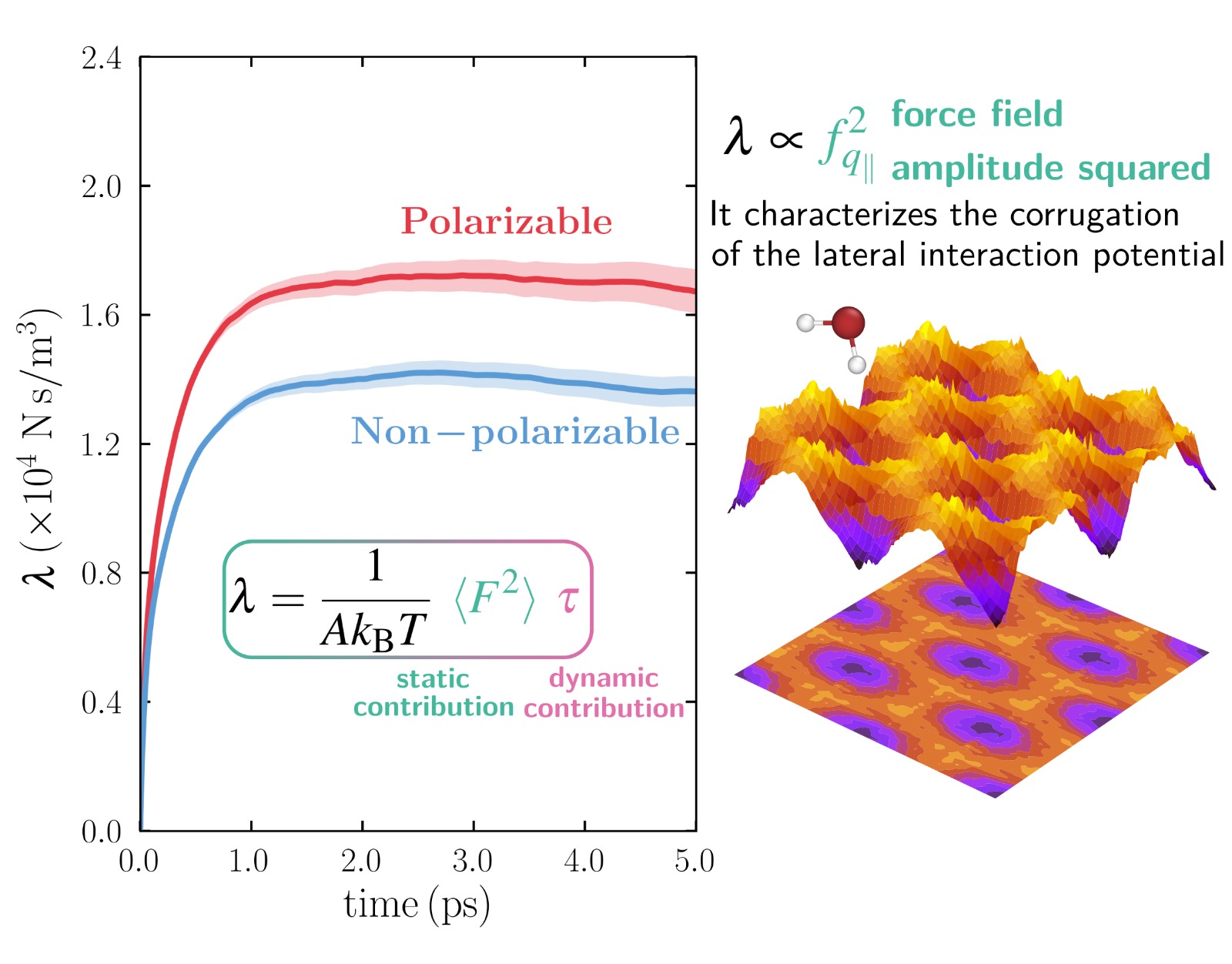
Early classical molecular dynamics simulations utilizing non-polarizable force fields es timated the water-graphene friction coefficient to be ~ 1.4x10⁴Nsm-3. However, recent studies have demonstrated that electric polarization and quantum effects beyond the Born-Oppenheimer approximation are crucial for accurately describing nanoscale friction. Observations from recent models suggest that incorporating electric polarization leads to higher predicted friction coefficients. This study evaluates the water-graphene friction coefficient from the SWM4-NDP polarizable water model interacting with both polariz able and non-polarizable graphene models. The friction coefficient is initially computed via equilibrium molecular dynamics (EMD) utilizing the Green-Kubo relation. Given the ongoing debate related to the application of this methodology, the friction coefficient of the fully polarizable system is also evaluated using non-equilibrium molecular dynamics (NEMD). Our EMD calculations show that incorporating explicit electric polarization in graphene increases the interfacial friction coefficient by 23%. Using enhanced-sampling simulations, we obtained that the free-energy landscape of a water monomer is more corru gated on polarizable graphene compared to the non-polarizable model. Quantitative anal ysis of these landscapes reveals that the friction increase caused by incorporating explicit polarization arises exclusively from a larger lateral force amplitude, which results directly from an enhanced energetic surface corrugation.
Back