
Researcher Profile
Research Interests
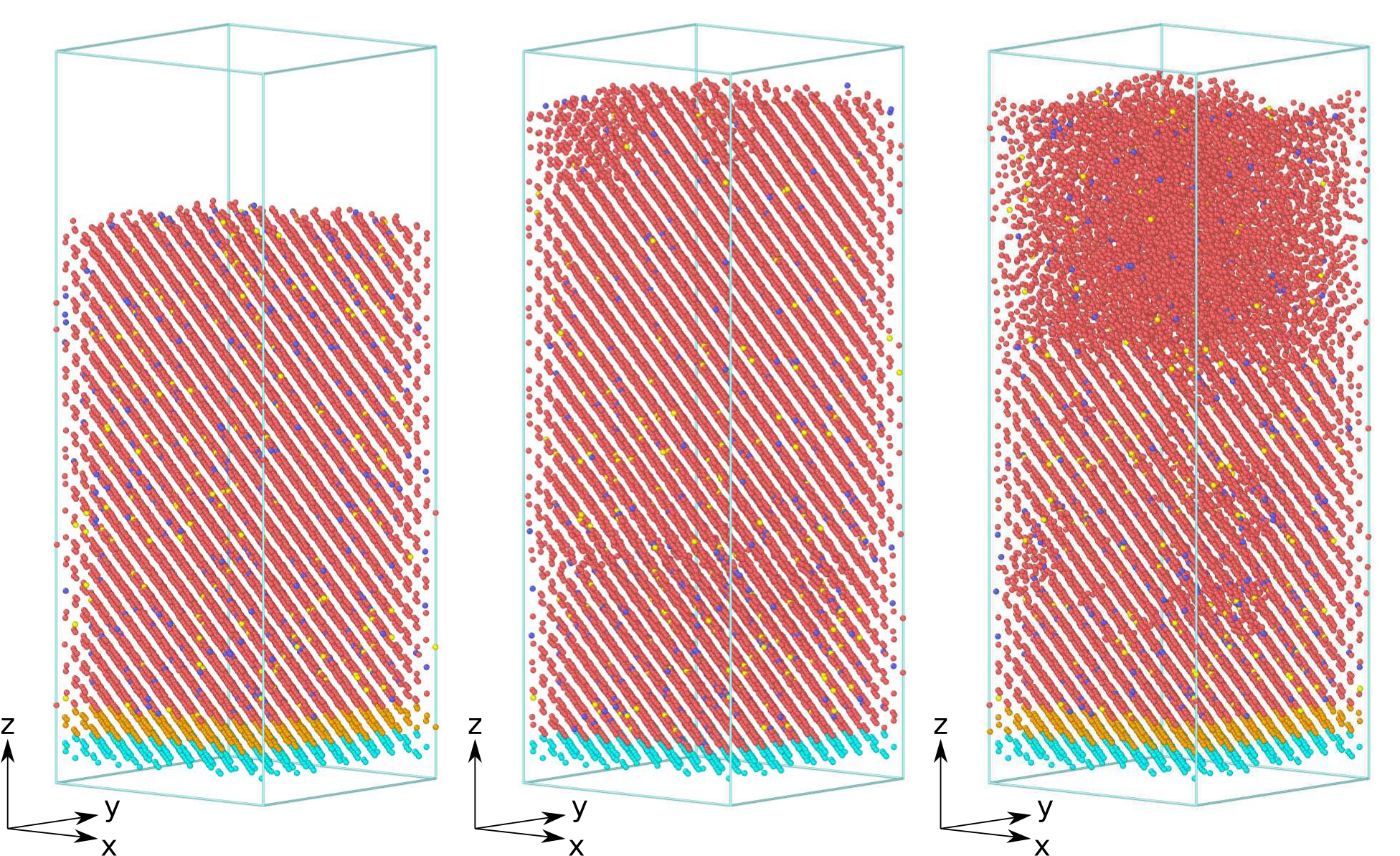
My research interests include atomistic simulation, fluid dynamics, electrokinetic transport, and material science. A key focus is using advanced numerical simulations to improve the fundamental description of transport phenomena in these systems. Currently, my work aims to use atomistic simulations to improve the description of the isotopic enrichment via ion irradiation of Silicon-28 layers for quantum computing architectures.
List of Publications
Polarizability in Graphene Increases Nanoscale Friction by Amplifying Interfacial Energy Corrugation.
Oyarzua E., Rojano A., Becerra D., & Wagemann E. (2026)
The Journal of Chemical Physics
Detail
Isotopic enrichment of silicon: A molecular dynamics study on 28Si ion implantation at low energies.
Rojano A., Jamieson D.N., Curry, R.J., & Murphy, S. T. (2026)
Physical Review B
Detail
Effect of charge inversion on the electrokinetic transport of nanoconfined multivalent ionic solutions
Rojano A., Becerra D., Walther, J. H., Prakash S. & Zambrano, H. A. (2024)
Physics of Fluids
Detail
A modified two temperature molecular dynamics (2T-MD) model for cascades
Rojano A., Hunt R.J., Crocombette J.-P., & Murphy S.T. (2024)
Journal of Physics: Condensed Matter
Detail
Effect of charge inversion on nanoconfined flow of multivalent ionic solutions
Rojano A., Córdoba A., Walther J. H., & Zambrano H. A. (2022)
Physical Chemistry Chemical Physics
Detail
Effect of an external electric field on capillary filling of water in hydrophilic silica nanochannels
Karna, N. K., Rojano Crisson A., Wagemann E., Walther J. H., & Zambrano H. A. (2018)
Physical Chemistry Chemical Physics
Detail
Talks
Atomistic Modeling of the Isotopic Enrichment via Ion Irradiation of Silicon-28 Layers for Quantum Architectures.
A Rojano, R Acharya, M Coke, M Adshead, DN Jamieson, RJ Curry, and ST Murphy
The 30th International Conference on Amorphous and Nanocrystalline Semiconductors (ICANS30), 2024
Manchester, United Kingdom
Detail
Atomistic Modeling of the Isotopic Enrichment via Ion Irradiation of Silicon-28 Layers for Quantum Architectures.
A Rojano, R Acharya, M Coke, M Adshead, DN Jamieson, RJ Curry, and ST Murphy
The 23rd International Conference on Ion Beam Modification of Materials (IBMM), 2024
Londond, United Kingdom
Detail Poster
Isotopic Enrichment of silicon: A molecular Dynamics study on Si-28 Ion Implantation.
A Rojano, J-P Crocombette, ST Murphy
The 16th conference of computer simulation of irradiation effects in solids (COSIRES), 2024
Kingston, Canada
Detail
Effect of Charge Inversion on Electroosmotic Transport in Nanochannels
A Rojano, JH Walther, D Becerra, HA Zambrano
73rd Annual Meeting of the APS Division of Fluid Dynamics, 2020
Chicago, United States
Detail
The electrokinetic transport of multivalent electrolytes: the effect of charge inversion
A Rojano, JH Walther, HA Zambrano
American Physical Society March Meeting, 2020
Denver (virtual), United States
Detail Video
Effect of Charge Inversion on Nanoconfined Flow of Multivalent Electrolyte Solutions
A Rojano, A Cordoba, JH Walther, HA Zambrano
72nd Annual Meeting of the APS Division of Fluid Dynamics, 2019
Seattle, United States
Detail
Effect of charge inversion on Poiseuille flow of multivalent electrolyte solutions in nanochannels: an atomistic study
A Rojano, A Córdoba, JH Walther, HA Zambrano
71st Annual Meeting of the APS Division of Fluid Dynamics, 2018
Atlanta, United States
Detail
Thermophoresis of water droplets inside carbon nanotubes
H Zambrano, JH Walther, E Oyarzua, A Rojano
69th Annual Meeting of the APS Division of Fluid Dynamics, 2016
Portland, United States
Detail
PhD Thesis
Effect of the Phenomenon of Charge Inversion over the Transport of nanoconfined electrolyte solutions
Thesis Committee
- Dr. Shaurya Prakash (The Ohio State University).
- Dr. Alejandro Karelovic (Universidad de Concepción).
- Dr. José Matías Garrido (Universidad de Concepción).
- Harvey A Zambrano (Universidad Técnica Federico Santamaría), advisor.
Abstract
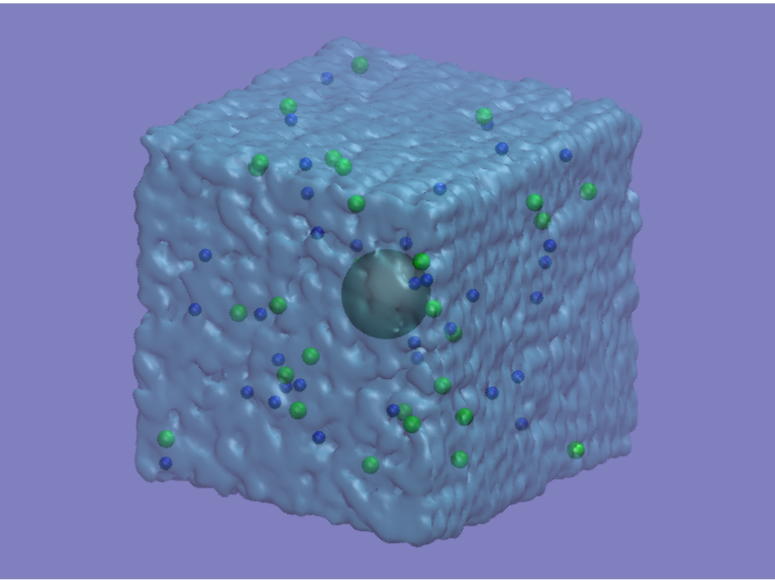
Miniaturized devices integrated by nanoconduits have a great potential for applications in different technological areas due to their amplified sensibility, faster response, and increased portability. For fluids confined in nanoconduits, the enormous ratio between contact area and confined fluid volume makes the interaction between walls and fluid a non-trivial subject. Hence, transport properties deviate from classical hydrodynamics, as it is no longer suitable to predict interfacial fluid dynamics. Additionally, in nanoconduits confining aqueous electrolytes, the electrical double layer may occupy an extensive part of the conduit cross-sectional area. Since applications of nanofluidic devices usually incorporate electrolytes, a comprehensive understanding of phenomena occurring within the electrical double layer, such as charge inversion, would provide innovative solutions for relevant technological challenges. In a nanochannel, charge inversion occurs as the charge density provided by the co-ions exceeds the charge density provided by counter-ions in a specific region of the electrical double layer. In this thesis, atomistic simulations are employed to study phenomena related to the presence of charge inversion in mixtures of monovalent and multivalent ionic solutions confined in charged amorphous silica nanochannels. In particular, equilibrium and non-equilibrium molecular dynamics simulations of Poiseuille, Couette, and electroosmotic flow are conducted. Specifically, this study examines the effect of charge inversion on flow velocity distributions, slip boundary conditions, electric potential, and fluid transport properties. The results show that charge reversal of the apparent surface charge is directly related to the valence number of the counter-ions. Accordingly, a higher overscreening on the wall surface produces a high-viscosity fluid layer adjacent to the channel wall that increases with the partial concentration of multivalent counter-ions. Indeed, higher values of the interfacial viscosity and the friction coefficient associated with the presence of an excess of multivalent counter-ions near the channel wall explain interesting phenomena that take place when charge inversion occurs. Moreover, the results of this thesis will elucidate the electrokinetic effects and phenomena occurring in silicon-dioxide aqueous electrolyte interfaces. Consequently, developing more practical models and theoretical frameworks to accurately describe electrokinetic phenomena and the boundary conditions in these types of systems.
Defense (June 2022)
Related research
Silicon enrichment
Solvation of charged surfaces
Software
A scientist by training and self-taught programmer, accustomed to working with people of different disciplines. I am interested in software development and open source science. Some of the programming languages I have worked with include Python, Fortran, Git, C++, and HTML. Furthermore, here are some highlights of my work related to computational science:
FASTTUBE: I first implemented functionalities and data extractions in the FASTTUBE molecular dynamics package at the beginning of my Ph.D. Additionally, I have mainly employed this software to assist with simulations and post-processing to study water droplets inside carbon nanotubes and over graphene sheets. LAMMPS: I have implemented functionalities to compute a type of Coulombic interactions using a smooth truncation. Morover, I have implemented functionalities to reformulate the traditional 2T-MD scheme to overcome the limitations on the treatment of the high-energy particles by addressing the spurious double-interaction of high-energy atoms with electrons. DLPOLY: I have implemented functionalities to reformulate the traditional 2T-MD scheme to overcome the limitations on the treatment of the high-energy particles by addressing the spurious double-interaction of high-energy atoms with electrons. Python: I have developed scripts for manipulating LAMMPS (and other software) data files and importing them with Python. Furthermore, I am proficient in data analysis and automation of processes and have the fundamentals of deep learning.
Some of the software I write is available in my Github and Gitlab profile. Everything there is open source and external contributions are encouraged.
Home